Read Time: 12 minutes
Cheers to the new year! And here’s to post number 25, ringing in the end of 2025!
And with any end, there is always a beginning. One that brings in the new and holds great potential! With the start of any cycle, along with any major life changes, there is a unique opportunity to start anew on habits lost, projects forgotten, etc. It is another godly cycle where we can move on from the past into the brilliance of the future God has given us. Thank and praise God!
This week typically comes with setting annual goals or New Year’s resolutions, and then unfortunately with breaking them. In fact, according to Forbes Health, resolutions last on average 3.74 months…much longer than I was even thinking.
All that being said, these ‘resolutions’ can be awesome and powerful tools for personal achievement and productivity – but more importantly for the glory of God! And while perhaps you have already started and broken one of them, like dry January, there is hope in sight (as of this article I have not!). This is being published on January 5th, and the number 5 just happens to be God’s number for grace. I had planned to publish this last week, but God sometimes has different plans and timing. So let’s all give ourselves some grace when it comes to our own plans – both in the lack of achievement and amount we are trying to get done!
In other words, cut yourself some slack as I did and start anew today. It is important to build grace into your resolutions and that’s a common thread amongst the recommendations below.
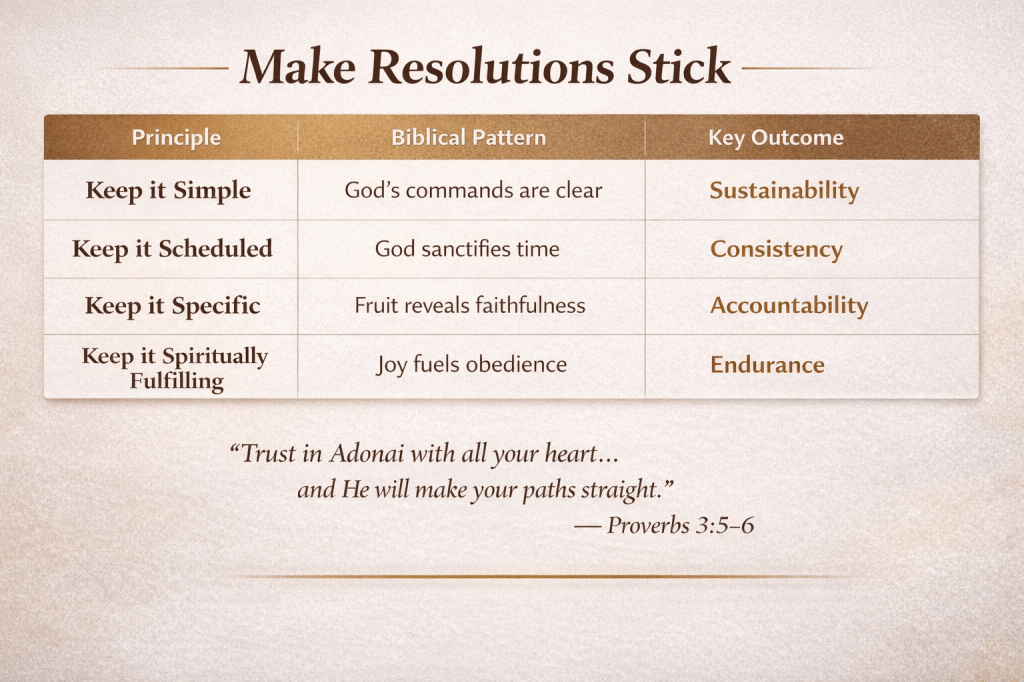
For the sake of simplicity and ease of implementing, I’ve outlined four key rules below that are both godly and helpful for making your resolutions stick. These are all timeless and well-vetted principles that are grounded in godliness (no coincidence there).
For each of the principles below, we will cover the following:
- The Biblical Foundation – it is always good and godly to stay grounded in scripture.
- Supporting Wisdom – guidance and interpretation by Torah / Bible scholars.
- Supporting Science – subject matter experts (both in industry and academia) who have found supporting evidence of these godly principles in the world (whether they know it to be godly or not).
Hope you enjoy this NEW and SIMPLE format! Drop a comment if so, and I will publish more like this.
1 – KEEP IT SIMPLE (KEY: SUSTAINABLE)
Biblical Foundation
Although God is infinite and too complex for our understanding, He admires, protects and blesses the simple. He is a God of clarity, focus, and directed completeness; not one who is fragmented, distracted, or attracted to complexity. Where the world markets complex as wise, God’s wisdom shows that this is only folly.
So as we attempt to create goals and resolutions, keep this principle in mind. Keep it simple. I’m tempted to quote the KISS principle, but for sake of godliness and simplicity, I’ll just leave it here and know that you get the point. 🙂
“All the words of my mouth are righteous, Nothing in them is perverse or crooked. All of them are straightforward to the discerning, and right to those who find knowledge.”
Proverbs 8:8-9 TLV
“The Torah of Adonai is perfect, restoring the soul. The testimony of Adonai is trustworthy, making the simple wise.”
Psalms 19:8 TLV
“Adonai protects the simple-hearted. When I was brought low, He saved me.”
Psalms 116:6 TLV
“He has told you, humanity, what is good, and what Adonai is seeking from you: Only to practice justice, to love mercy, and to walk humbly with your God.”
Micah 6:8 TLV
Supporting Wisdom (Rabbis & Pastors / Sages & Scribes)
How about a quick story to showcase godly simplicity. Rabbi Hillel was famously asked to summarize the Torah while standing on one foot. His response:
“What is hateful to you, do not do to your fellow. The rest is commentary—go and learn.” (From the Talmud, Shabbat 31a)
Similarly, with more eloquence, Yeshua our Messiah, put it this way:
“But the Pharisees, when they heard that Yeshua had silenced the Sadducees, gathered together in one place. And testing Him, one of them, a lawyer, asked, “Teacher, which is the greatest commandment in the Torah?” And He said to him, “‘You shall love Adonai your God with all your heart, and with all your soul, and with all your mind.’ This is the first and greatest commandment. And the second is like it, ‘You shall love your neighbor as yourself.’ The entire Torah and the Prophets hang on these two commandments.””
Matthew 22:34-40 TLV
Supporting Science (or Secular Experts)
Experts talk a lot about focusing less on willpower and more on the environment you create around a task. In other words, make it easier or simpler to start and/or complete the habit. James Clear, who we could quote repeatedly in this article, as he is one of the foremost experts on habits, calls this seamless setup “reducing the friction.”
In his bestseller, he states:
_“Before you try to increase your willpower, try to decrease the friction in your environment.”
This can be something like setting your shoes out the night before. Or creating your to-do list the day before. Even setting your phone in another room. These simple actions help set you up for success.
God wants you to be successful. So any ways you can reduce the friction in your life, especially to perform godly acts of obedience, this can have profound effects on your wellbeing. This isn’t to say that you won’t hit roadblocks, because you will. And you will have stress and obstacles, but don’t confuse setting your environment (i.e. the setup) with doing. When you set your environment it should be easier to get started. But once you get started, that’s where the fun, struggle and growth begins!
2 – KEEP IT SCHEDULED (KEY: TIME-BOUND)
Biblical Foundation
Our God is a God of appointed times or moedim (מועדים). Interestingly enough, when I use google translate, moedim is translated to mean “deadlines” or “due dates.” How appropriate here!
The fact is that due dates create structure. And even those that we set for ourselves create necessary pressure to get the work done. Spiritual life in scripture is sober, structured and straightforward. In fact, the path to righteousness is always described as the ‘narrow’ path.
For us to follow on the narrow path, we must walk straight, upright and with precision. We must be accurate, and for this need to have well-defined targets and action plans. Specifically, these actions need to make their way onto a calendar. We need to define the when and where we are doing them.
This is to be continued in the next section, but just remember, all goals, habits, or actions need to be scheduled! Block the time now.
““Speak to Bnei-Yisrael, and tell them: These are the appointed moadim of Adonai, which you are to proclaim to be holy convocations—My moadim.”
Leviticus 23:2 TLV
“Now when Daniel learned that a written decree had been issued, he went into his house, where the windows in his upper room opened toward Jerusalem. Three times a day he knelt down, prayed and gave thanks before his God, just as he did before.”
Daniel 6:11 TLV
““This month will mark the beginning of months for you; it is to be the first month of the year for you.”
Exodus 12:2 TLV
“For everything there is a season and a time for every activity under heaven:”
Ecclesiastes 3:1 TLV
Supporting Wisdom (Rabbis & Pastors / Sages & Scribes)
In addition to the set apart days and times, which are to be kept according to God’s calendar, there are many other timely and time-bound elements to serving God. There are certain prayers for one (e.g. Modeh Ani, Shema), which should be done in the morning, both to ground us and glorify God. Likewise, Shabbat (which is actually an appointed time in and of itself), must be observed every seven days.
Coincidentally (or perhaps not), Rabbi Abraham Joshua Heschel, who we have quoted before on this site, said in his book entitled The Sabbath that:
“Judaism is a religion of time aiming at the sanctification of time.”
Finally our Chief Rabbi Yeshua Moshiach frequently went early in the morning to pray, supporting several points above. Although I doubt it was on his calendar, because it was so ingrained in his being. He certainly sought first the Kingdom of God!
Supporting Science (or Secular Expertise)
Both Charles Duhigg (The Power of Habit) and James Clear (Atomic Habits) speak of cues as elements of habit formation – arguably as the first and most important.
James Clear goes as far to say:
_“The cues that can trigger a habit come in a wide range of forms…but the two most common cues are time and location.”
Furthermore, he says these are critical for intention formation, and shows that people who write down their intention with time and location (specifically day and place), were 3x more likely to complete an activity. More specifically, the participants in the referenced study who wrote down their intention completed the activity 91% of the time, as opposed to those who were simply ‘motivated’ and completed the task about 30%. This is based on a study published in the British Journal of Health Psychology.
As you can see, although we like to rely on our willpower and motivation alone, this is in most cases not enough. For one, we need God. And two, he has given us some timely principles in his Word. 🙂
So when we schedule the activity and it is tied to a concrete action plan, our odds of achieving and sticking with our goals increase. Let’s go and get these actions scheduled!
3 – KEEP IT SPECIFIC (KEY: MEASURABLE)
Biblical Foundation
Sticking with the theme of spiritual precision, like an archer, we must define our targets well, less we shoot at the sky and the arrow comes back to hit us!
With this in mind, God values specificity and clarity. Which is why He spent so much time with those charged with documenting His word. On top of this, He is a God of mathematics and numbers. He created the universe which is perfectly logical and founded in the most wonderful of mathematics, if you look close enough.
Similar to that of mathematics, He consistently holds us to account. His word is a living and breathing accountability tool. He is concerned of our growth and prosperity, both physically and spiritually. If we are to be “account-able,” we have to start to count. Though we can never count the hairs on our head, the sand on the seashore, or the stars in the sky, we can try to count our blessings and count our progress towards glorifying Him!
Counting also helps us to tell stories. It provides the magnitude and depth of insights, which move us and others to action.
“Walk about Zion, go around her. Count her towers. Consider her ramparts, go through her palaces, so you may describe it to the next generation. For this God is our God, forever and ever! He will guide us to the end.”
Psalms 48:13-15 TLV
“So then each one of us shall give account of himself to God.”
Romans 14:12 TLV
“I would give Him an account of my steps; like a prince I would approach Him.”
Job 31:37 TLV
“He determines the number of the stars. He gives them all their names.”
Psalms 147:4 TLV
“So teach us to number our days, so that we may get a heart of wisdom.”
Psalms 90:12 TLV
Supporting Wisdom (Rabbis & Pastors / Sages & Scribes)
Consistently we are taught that we will be known by our fruit. And how are we to know that if we are bearing fruit unless we work and then take an account of the growth and results.
Moreover, Rabbi Samson Raphael Hirsch, a 19th century German Orthodox Rabbi is credited with saying:
“What is counted is cherished. What is measured is guarded.”
This is profound as it can be taken multiple ways – depending on if what is being counted is godly and spiritual or worldly and physical. Of course we don’t want to lay up treasures here on earth, but on the other hand we need to be good stewards of the talents and resources God gives us. Similarly, if we take account of spiritual fruit, we will cherish more the benefits and results of our labor in such.
And don’t forget, we will all be called to account for our actions. So let’s focus on what matters!
Supporting Science (or Secular Expertise)
There is a well-known acronym in the field of management science when it comes to goal-setting known as setting SMART goals. SMART stands for SPECIFIC, MEASURABLE, ACHIEVABLE, RELEVANT, and TIME-BOUND.
There are variations to this, but the main facets of the acronym and associated principles are by and large the same. The focus here is on the Specific and more specifically Measurable. Because in order for something to be measurable, it has to be specific. That’s why I think it is better to focus on the measurable.
For example, you should not set a goal to lose weight. Not because it isn’t a valuable goal, but because it’s not specific or measurable. Because how do you measure whether or not you have lost weight. You need a starting point at minimum, and an ending point. Taking this one step further, you need to define milestones and specific goal posts. In other words, do you want to lose muscle mass? Well, probably not. And do not want to lose weight in spite of other key health metrics? Well no, of course not, because health is probably the point of you losing weight. If it is not, I would question if it is godly.
And this leads us to a probably more important point than simply measuring. You have to make sure you are measuring the right thing and with the right methods and motives. In an all too often quoted or perhaps misquoted phrase “You can’t manage what you don’t measure,” it is also misattributed both to Peter Drucker and W. Edwards Deming. And while the spirit behind this is intended for good – i.e. using data for proper improvement actions – we need to take caution that we use the tools in the right way. Measurements in and of themselves are a tool, a data point. But a hammer used to cut a piece of wood won’t work well. So make sure you have the right data and the right ‘why behind the what.’ Then you can at least get started with proper accounting. And to do proper accounting, you have to know the rules and regulations. So measure, but measure properly! Or perhaps we should say, measure righteously! 🙂
If godliness is the motive, then you know you have the right foundation and tools to start building the house.
4 – KEEP IT SPIRITUALLY FULFILLING (KEY: JOY!)
Biblical Foundation
Joy is not an optional element of serving God. It is commanded! How amazing is our God that He cares so deeply about our spiritual fulfillment!
So as you walk out your days with God, keep it simple, keep it scheduled (block out time for God), keep it SMART, and keep it spiritually fulfilling. God even created an entire appointed time for rejoicing (read: Sukkot); how about that for an “all-in-one” example of what we spoke about above!
If we are to be a light unto the nation, we have to be lighthearted and fun to be around. People need to be drawn to us to learn more about God and Yeshua (God is Salvation). So if there is only one thing you apply today, be happy and rejoice – for God is good!
“Rejoice in the Lord always—again I will say, rejoice!”
Philippians 4:4 TLV
“Rejoice always, pray constantly, in everything give thanks; for this is God’s will for you in Messiah Yeshua.”
1 Thessalonians 5:16-18 TLV
“Serve Adonai with gladness. Come before His presence with joyful singing.”
Psalms 100:2 TLV
“Consider it all joy, my brethren, when you encounter various trials, knowing that the testing of your faith produces endurance. And let endurance have its perfect work, so that you may be perfect and complete, lacking in nothing.”
Jacob (James) 1:2-4 TLV
Supporting Wisdom (Rabbis & Pastors / Sages & Scribes)
Joy is a softball for pastors and rabbi’s alike. In fact, there probably isn’t a Church on Sunday where there isn’t singing and praising. Perhaps this is part of the jealousy prophesy, but that is for another day.
Point being is that many Christians are really good at portraying joy. Sometimes and in some cases Catholics, Protestants, Jews are more serious and sober in their approach. Which is not bad at all, but we ALL need to show our love for God and humanity (made in His image). We ALL are called to be lights unto the world. And if we are ALL to flicker like a candle, shouldn’t it be with pure joy and fulfillment?
The Talmud states:
“The Divine Presence does not rest where there is sadness, but where there is joy in fulfilling a mitzvah.” -Talmud, Shabbat 30b
Likewise, Pope Francis, who perhaps does not even realize the depth, timeliness and profundity of his statement, eloquently stated:
“A Christian is one who is invited… to join in the feast, to the joy of being saved, to the joy of being redeemed, to the joy of sharing life with Christ. This is a joy! You are called to a party!”
So keep counting and while you do…count it all joy!
Supporting Science (or Secular Expertise)
There was a fascinating study published in the journal Social Cognitive and Affective Neuroscience in 2016 which experimented with ‘positive mood’ and ‘goal-directed behavior.’ In other words, showcasing how joy can positively influence our efforts towards activities that pursue our goals (or resolutions in this case). In the study, 40 subjects were given MRIs and presented with mood induction surveys to gauge initial moods. Then, the subjects performed an exercise where they were literally required to hit a target using a computer to either win or lose money. Throughout the trials, they were given mood-boosting positive affirmations and mood-boosting music.
The results are very cool…
Discussed in the survey results are the following findings:
- “Positive mood increases activity in neural regions that assign meaning and value”
- “Positive mood increases activity in neural regions important for motivation”
- “Positive mood increases activity in neural regions that facilitate behavior in order to attain reward”
The takeaway here is clear. Joy or having a positive mood, perhaps even when you don’t “feel like it,” can have profound affects on our neurobiological mechanisms which stimulate our actions towards goals.
Secondarily and indirectly related to this, shouldn’t we take every precaution surrounding our health (both physical and mental) to ensure that we maintain a positive mood. In other words, ensuring that we get enough sleep, eat well, and exercise. These simple habits can have domino effects as we see above!
Sources (Extra-biblical)
Clear, J. (2018). Atomic habits: An easy & proven way to build good habits & break bad ones. Avery.
Clear, J. (n.d.). Achieve your goals: The simple trick that doubles your chances for success. JamesClear.com. https://jamesclear.com/implementation-intentions
Davis, S. (2023, December 18). New Year’s resolutions statistics. Forbes Health. https://www.forbes.com/health/mind/new-years-resolutions-statistics/
YEC. (2018, December 4). You are what you measure. Forbes Councils. https://www.forbes.com/councils/theyec/2018/12/04/you-are-what-you-measure/
Takeaways to make a way (Practical Advice)
- Choose 1-2 Habits to focus on, not 5 (God values simplicity and clarity!).
- Simple is sustainable.
- What gets scheduled gets done (and sanctified!).
- Track frequency with grace (without judgment but for learning).
- What gets measured (correctly) gets managed.
- Serve God with joy!
- Celebrate the small wins as fuel to your spiritual fulfillment!
Further Study with your Buddy
If it’s more mindset techniques you are after, learn how to develop a Seek First Mindset: God’s Plan Part 2: SEEK FIRST the Kingdom of God
For more spiritual fundamentals, read Supercharge your Spiritual Strategies (5 ways to to use NLP for godly purposes)
For more discussion on habits, read The Chukat Concept: Engraving wisdom to form godly habits that change your life
Questions for Reflection…
- What are your new year resolutions (if you don’t already have them)?
- How could you simplify or pick 1-2 to focus on?
- When (time and location) will you do each activity?
- Is there a current activity or routine you could attach them to?
- How do these new year resolutions serve God?
- Do they ALL stand up to the test of godliness (i.e. scripture)?
- Did you take the time to pray about your resolutions?


Thank you for these words of wisdom in finding ways to reach our purpose!
LikeLiked by 1 person
This is just fabulous Jake! I loved the way you presented and organized the information/ very positive and motivational!!
LikeLiked by 1 person