Read Time: 12 minutes
“Our God…is an awesome God, He reigns…”
That was one of my favorite songs growing up. But have you ever taken a moment to think about what the word awesome really means? According to Merriam-Webster, Awesome is officially defined as “inspiring awe,” but I think of it more as “being in awe” of something worthy of awe.
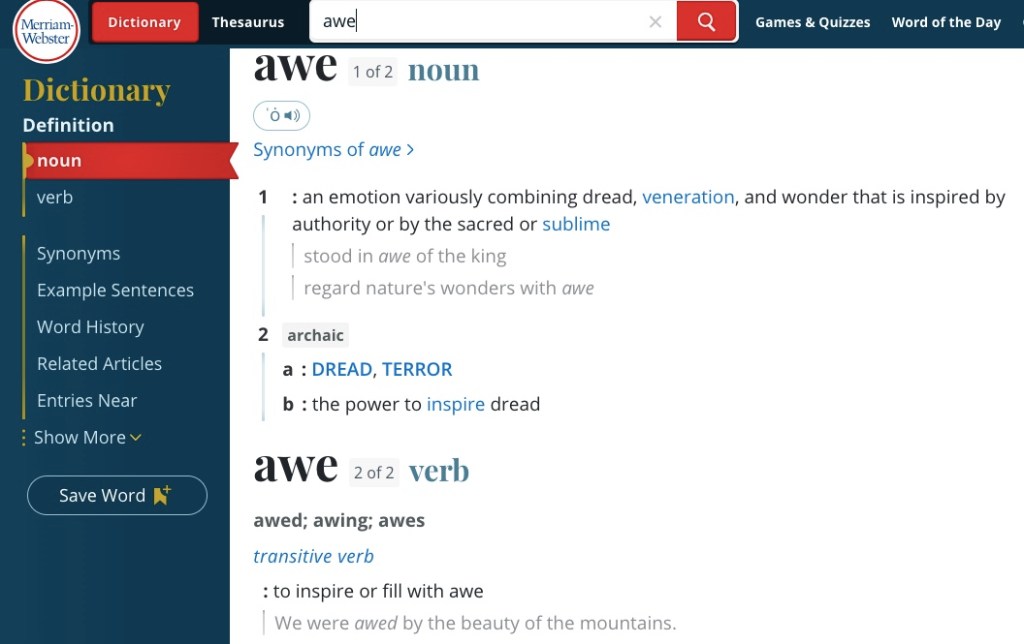
We see here that the Merriam-Webster Dictionary perfectly encapsulates the concept of awe by wrapping together fear (dread even), veneration, and wonder. They even go as far as tying it to something sacred and defining it in the context of “stood in awe at the king.” How cool is that?
This is exactly the kind of awe that I think of when I stand in awe at our future King and current suffering servant and Savior, Yeshua HaMashiach (Jesus the Messiah).
Now look what happens when we now search ‘awesome’ in the same dictionary.
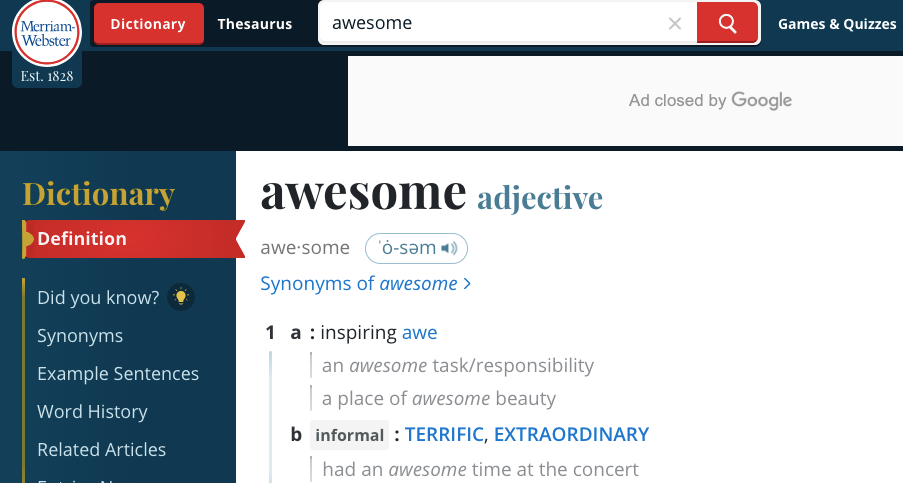
Of course the first definition is simply an extension of awe, but it quickly transitions to the informal definition just below this and defines awesome as “terrific, extraordinary.” While our God is certainly terrific and extraordinary, we can also see that the context used by the dictionary also slides from “a place of awesome beauty” in the first definition to “had an awesome time at the concert.”
While there is nothing blatantly wrong with using awesome in this context, it makes you wonder how something can shift from awe-inspiring sacredness or awe-struck beauty to simply rocking out at a concert. It becomes a diluted version of its root word, used in the most benign of places.
Side note: I realized as I was editing this post that Merriam-Webster also feels the same about this contextual dilution. For a laugh, go search the site yourself and read the “Did you know” blurb underneath the definition of awesome.
Unfortunately this shift or mixing of sacred and secular happens all too often in our world. It is also what happened in creation. Adam and Eve were in an awesome garden, walking with God and enjoying His awesome presence and masterpiece of creation. The place was filled with His awesome glory and the world was in perfect peace and harmony.

We all knows how the story ends, but the climax of the story unfortunately invokes this similar, yet faintest form of deception. That sly transition and dilution that we saw earlier was certainly at play in creation and in our every day lives today. It is the micro-corruption of God’s purpose and intention, just to the point where we think we can takeover and act as our own “mini-creators,” as Rabbi David Fohrman calls it in his brilliant lecture on the meaning of life (Aleph Beta: What is the Meaning of Life?). The little white lie becomes a devastating monster quickly. Did God really say X? Did He really say you couldn’t do Y? What’s the harm if we just do Z?
The Bible says the adversary comes to steal, kill and destroy (John 10:10). The strongest method by which to do so is through deception. As Agathe Christie once wrote, “What tangle webs we weave, when first we practice to deceive.”

By this faintest of acts, the word awesome drifts into our vocabulary to describe a meal, a person, or even a car. Worst even, this benign object becomes our obsession, or even an idol. All of the sudden, “awesome” permeates every sentence or conversation, converting at once something that was pointing towards the sacred, to another thing which is entirely secular or even evil. Catch my drift…?
While you may have an awesome ride, is it really awesome? Does it really inspire and move you like a beautiful scene of mountains or gazing over the ocean. Maybe if you are a true ‘gear head,’ but even that is not quite awe. The things that truly inspire awe were created by our true Creator, not ourselves. And we need to be extremely careful that they do not take the second shift from benign and playful to harmful and idolatrous. Knowledge and understanding are both key. We need to be aware of the words we speak, there is power in the tongue (James 3:4-3:8).
“That day the Lord exalted Joshua in the sight of all Israel; and they stood in awe of him all the days of his life, just as they had stood in awe of Moses.” (Joshua 4:14, NIV)
“Then Samuel called on the Lord, and that same day the Lord sent thunder and rain. So all the people stood in awe of the Lord and of Samuel.” (1 Samuel 12:18, NIV)
Brief Introduction to Computational Thinking
As we shift gears from etymological constructs to computers and artificial intelligence, it is first important to understand the basics or logical foundation of machine language or algorithmic coding – computational thinking.
Computational thinking is a subset of computing which attempts to apply logic and critical reasoning methods in the formulation of models or algorithms to solve every day problems. This can be as simple as making a decision on groceries, or as complex or morally critical as to whether an autonomous car should swerve right to hit an elderly man while avoiding a child to the left. The Old Man is okay by the way, but the car doesn’t know that! It simply uses different variables, such as cost, convenience, or health concerns, weighs those accordingly, and provides a decision output or response.
However, we can see from the more intense car example how quickly the applications of computational thinking shift from generally inconsequential problems (grocery purchases) to deep moral implications (life or death). Ultimately, it is an outsourcing of our decision-making abilities – that which makes us most holy – the free will to choose one path or the next. It allows an artificial intelligence to either replace or complement our own decision-making mechanisms. Although, we can easily drift into autopilot and allow the machine to take over completely.
A perfect example is your Spotify or Pandora playlist. Unless you specifically picked every song and manually added it to your playlist, the algorithms have used computational thinking to select the songs to which you are listening. Even if you play a song that was recommended, you are slowly starting to depend on artificial intelligence. As much as we would like to think there are music experts who are busy each day simply looking for songs which we might like, it is only the people who have created the algorithms which are involved in this transaction.
But before we write off all computational thinking as a whole, and say that anything that models reality is not valuable, we can remember and rest in the fact that God created mathematics, physics, logic and all natural laws. Just as he created the spiritual laws. In fact, God demonstrates spiritual principles and lessons in the physical, but this is for another time.
“But it is not the spiritual that is first but the natural, and then the spiritual.” (1 Corinthians 15:46, ESV)
Therefore, it is important to note that there are in fact truths in math. Most simply, 1 + 1 = 2. There are also more complex “proofs” which show us how these different truths work together and interact. They are the building blocks of truth. Much like how we understand biology, layer by layer, cell by cell, function by function, bird by bird.
Unfortunately, as aforementioned, the adversary has come here to steal, kill and destroy. And this includes an attack on the truth – both from our perception and also by mixing reality with “virtual reality”. Deception is the adversary’s most powerful weapon here. This is why it is important to be ever mindful and cognizant of the world that we live in, as it is becoming corrupted through micro-deceptions more each day. And that we also challenge each proposed truth, holding it up to His truth. Only that which stands up to the living and breathing Word of God can be true.
“For by him all things were created, in heaven and on earth, visible and invisible, whether thrones or dominions or rulers or authorities—all things were created through him and for him. And he is before all things, and in him all things hold together.” (Colossians 1:16-17, ESV)
“Then the LORD God said to the woman, “What is this that you have done?” The woman said, “The serpent deceived me, and I ate.”” (Genesis 3:13, ESV)
“and the devil who had deceived them was thrown into the lake of fire and sulfur where the beast and the false prophet were, and they will be tormented day and night forever and ever.” (Revelation 20:10, ESV)
Models & AI vs. Truth & Reality
The fact is models can never be proven true. They can only be trained, validated, tested, improved and “optimized”. They will always be subject to both bias and variance. The impact of randomness is what we call it, but we both know what it really is.
Similarly, a hypothesis can never be accepted. In fact in statistics, we either “reject the null hypothesis” or “fail to reject the null hypothesis.” It is just like a courtroom. In our court system within the United States, one can either be guilty or not guilty. There is no verdict of innocence. Besides, none of us are 100% innocent of anything. And the “truth” of guilt is not even a result in our justice system. It is simply that the jury must agree that the prosecution has proven “beyond a reasonable doubt.” We use thresholds, predictors, models, formulas, algorithms and recipes, because that’s all we are doing in this life – working with the information (and faith) available to make educated guesses and decisions, at best. Yes, there are some fundamental truths (in His Word). Yes, there is clear right and wrong (in His Word). But our life is not filled with obvious choices as Capital One would like you to believe…We have free will for a reason, and God is the only One who knows all truth. The fact remains, all us adults are just children with bigger problems, trying to figure out the best way to navigate this world.
“Therefore, my beloved, as you have always obeyed, so now, not only as in my presence but much more in my absence, work out your own salvation with fear and trembling, for it is God who works in you, both to will and to work for his good pleasure. Do all things without grumbling or disputing, that you may be blameless and innocent, children of God without blemish in the midst of a crooked and twisted generation, among whom you shine as lights in the world,” (Philippians 2:12-15, ESV)
“For the time is coming when people will not endure sound teaching, but having itching ears they will accumulate for themselves teachers to suit their own passions, and will turn away from listening to the truth and wander off into myths.” (2 Timothy 4:3-4, ESV)
Nevertheless, we do know that His word is true. We can rely on what we are given in scripture. While it may seem just as easy to rely on that text from our boss, or that app that can write you a 10 page paper in a few minutes, we must be very careful to separate mere predictions and artificial intelligence from true knowledge and understanding. Kadosh (קדוש), which is the Hebrew word for holy, literally translates as separated. Therefore, we are to separate ourselves and things which are unholy from holy. In fact, the Cherubim were placed outside of the garden of Eden to separate man from His garden. Likewise, in the mishkan or tabernacle, the cherubim were fixed to things which separate or create barriers (e.g. the ark of the covenant, the curtains, etc.).
We may have the confidence to rely on something based upon facts and data, but the truth exists regardless of arguments, models, or scientific data. We must separate truth from mere models. These models or algorithms only help us to explain and navigate the world. They help solidify our plans, actions, and decisions. But they are not true in and of themselves.
P.S. One of my favorite quotes we use at work is below. This is a good way to bring God into the workplace, while showing that only His truths are trustworthy.
####“In God we trust. All others must bring data.”
                    ####-W. Edwards Deming

The Beginning of Wisdom & End of this Examination
Getting back to the beginning (heh, see what I did there), the song continues with “He reigns from Heaven above with wisdom, power and love…” And okay, I admit, I have to finish it, “…Our God is an awesome God!”
Anyways, it is interesting that wisdom is brought forth here as the first word, because the Bible confirms in a handful of different verses that the world, our universe, the cosmos, and everything we know, was created through wisdom.
“It is he who made the earth by his power, who established the world by his wisdom, and by his understanding stretched out the heavens.” (Jeremiah 10:12, ESV)
“By wisdom a house is built, and by understanding it is established;” (Proverbs 24:3, ESV)
“O LORD, how manifold are your works! In wisdom have you made them all; the earth is full of your creatures.” (Psalms 104:24, ESV)
Even more intriguing is that in the beginning, in the first chapter of the Bible, it even says Let US make man in OUR own image (Gen 1:26-27). The verbs and adverbs used here are all conjugated in the “we” tense. For those not familiar with verb conjugation (we don’t have it it in English), it is simply a different end form of a word to denote who is performing the action (e.g. I, you, he, she, they, etc.). Who is God speaking to here? Many purport that He is speaking to the Angels, or He is speaking to Himself in the plural, because he is our Elohim, which is also in the plural. However, Elohim is not in the plural from a normal sense. It does not refer to the trinity, it refers to the omnipresent, omnipotent God. It is referred to as the “plural of potential.”
However, every jot and tittle is purposeful in our word. This is why Yeshua also makes it a point to use this phrase in one of his sermons (Mat 5:18). This is also why the Word was referred to as wisdom, and the concept of wisdom has become intertwined with the Word.
“The law of the LORD is perfect, reviving the soul; the testimony of the LORD is sure, making wise the simple; the precepts of the LORD are right, rejoicing the heart; the commandment of the LORD is pure, enlightening the eyes; the fear of the LORD is clean, enduring forever; the rules of the LORD are true, and righteous altogether.” (Psalms 19:7-9, ESV)
Speaking of Yeshua (Jesus), the Word made flesh, perhaps when God is referring to “US” and using “we” verb conjugation, He is referring to Him and His Son, Yeshua. Let’s look at some justification text for where this concept comes from.
“In the beginning was the Word, and the Word was with God, and the Word was God. He was in the beginning with God. All things were made through him, and without him was not any thing made that was made. In him was life, and the life was the light of men.” (John 1:1-4, ESV)
Further, if the Word was made flesh, as Yeshua our Messiah, then it would fit perfectly into the concept of the Word also being our Wisdom, and the earth being made through wisdom.
The Hebrew word used in the above passages in Jeremiah and Proverbs is Chochmah (חָכְמָה). Strongs translates this word as:
_wisdom (in a good sense): - skillful, wisdom, wisely, wit._
The sages describe this type of wisdom as the wisdom of potential, because Chochmah can be deconstructed into “Choach” or “potential” and “mah” or “what is.” So Chochmah is necessarily the wisdom of potentially what could be. It is a visionary sense of wisdom, interwoven with creativity and an understanding of purpose.
This is such a beautiful concept and shows some of the hidden treasures embedded in His Word. We will certainly return to this study in a later post, but pause for a minute and reflect in awe at this amazing concept – how is wisdom, power and love all encapsulated in our amazing God, His creation, His Word, and His Son. Words hold the power of truth and deception, and His Word, our Messiah Yeshua (Jesus) is the ultimate example of that. We must be cognizant of the potency of words and how each time we speak, we are breathing something into existence. Albeit not even close to the Creation of mankind and earth itself.
But the next time you describe something as awesome, perhaps you will think twice… 🙂
The same thing can be said for the word love. Do you really love that pizza? I mean, I know it’s good, but do you love it in the same way you love your wife. Maybe don’t answer that.
It is a completely different level. And there are levels to all of this: truth, wisdom, deception, models, algorithms, you name it.
Ultimately, we cannot begin to fathom His wisdom. We cannot even perfectly explain His perfect creation. Although we are made in His image, we cannot replicate His abilities. Thus, let us honor Him through the models we create. Let us enjoy nature, mathematics, and the laws of physics. But we must be very careful to always separate God’s truth from what is man made. And we must avoid at all costs to worship the work of our hands.
“The fear of the Lord is the beginning of wisdom, and knowledge of the Holy One is understanding.”
Proverbs 9:10 NIV
https://proverbs.bible/proverbs-9-10
Further Study with your Buddy…
If you are craving to learn more about creation and our God’s infinite wisdom, go back and read “Our God is one of Peace and Order”
To gain a further glimpse into the power of words and our societal constructs around them, read LOL (Love -> Obedience -> Love)
Questions for Reflection…
Are there any words that you use which have drifted from their intended meaning or purpose?
Are there are lies that you have been led to believe and thus relied upon them?
How can you be more aware of the truth? And how can you separate this truth from “artificial reality”?
How awesome is our Creator!?


3 thoughts on “Going Against the Algorithm: a Brief Examination into Wisdom & Creation”