Read Time: 18 Minutes

Side Note: This is Part 2 of a series of posts. If you haven’t read Part 1, some components of this may be confusing (especially starting at Stage D below). Nevertheless, you can always choose your own adventure and skip ahead – that’s free will!
Another Side note: As I was trying to write another article for this blog, I was hit with obstacle after obstacle. The oppressor puts roadblocks in our way. But what he plans for evil, God plans for good. Our resilience muscles are strengthened in the process, and resilience is a super important life skill – all for the glory of God! I think about the Joseph story a lot in this context.
“Okay great,” you say. “Now I (think I) have found my passion, but I have hit so many barriers, walls, obstacles, roadblocks, that it seems everything is against me.”
That just means you are on the right path my friend.

When the adversary knows that he is in trouble, he will try every method of frustration and deception at his disposal to throw you off your path. But remember, it is God’s will that prevails in the end. Just remember the story of Job! All glory be to God!
And while God does not test or tempt us, He will certainly allow humans to go through fire, trial and tribulation. This is part of the growth process. If someone grabbed the weights from you (either literally or metaphorically) every time you lifted something heavy, you would never build any muscle. And even worse, you would begin to expect that this is happening each time, so you would not even learn the skill to lift something, let alone the desire for struggle and growth. Because this is also a muscle you have to build. But once you wake up and truly “yearn to learn” or develop a growth mindset, you will unlock a lot of doors and possibilities you did not even imagine. God-granted growth is the key source of happiness, not achieving goals, and definitely not immediate satisfaction. These are like drugs – man-made and effects short-lived. If we don’t learn to love the growth process, and thank God for his glory and grace, we would only focus on the initial dreaming or brief reward stages. We must realize the joy and blessing of the wilderness, where God speaks to us on the journey of growth. But that is for another post.
“Count it all joy, my brothers, when you meet trials of various kinds, for you know that the testing of your faith produces steadfastness. And let steadfastness have its full effect, that you may be perfect and complete, lacking in nothing. If any of you lacks wisdom, let him ask God, who gives generously to all without reproach, and it will be given him. But let him ask in faith, with no doubting, for the one who doubts is like a wave of the sea that is driven and tossed by the wind.” (James 1:2-6, ESV)
We are told to “count it all joy.” What a beautiful way to look at obstacles or trials. They are part of the journey of growth and understanding. We need to notice the nuances, the bends and curves of the road if you will, or the seemingly endless hills and plateaus. They are not just means to an end, but rather opportunities for us to learn, grow, and prove what we have learned. They are the scenery on the horizon, what creates character and curiosity.
There’s a song by Billy Ocean that goes “when the road gets tough, the tough get going.” And while this is perhaps in search of a different kind of passion, we can certainly use difficulties in the road to showcase both physical strength and mental toughness (and our faith in God!). And when we do break down on the side of the road, what a perfect time to go to God in prayer!
Mental toughness is something that is becoming more rare these days. As we live in an era of convenience and immediate gratification, opportunities for us to learn and struggle must be sought out. This is why people go to the gym now, instead of just walking miles to the river for water or even the factory outside of town. The days of two hour commutes one-way by foot or bike are long gone as we now wake up, immediately have a coffee and get to work. We are forced to track calories on our phone because finding food is easier than finding a quiet place to walk and enjoy nature.
In similar fashion, participation trophies are now common. And I mean this both in the metaphorical sense and literal sense. We pay attendance bonuses for people simply showing up to get paid. We give actual trophies and rewards to all teams in children’s sports leagues. And while the purpose is understood, how does this prepare children for when they are not accepted into a school, a job or even a group of friends. Failure is normal, we are humans. And while effort is good, learning and growth are better. We need to work smarter not harder. Society is filled with examples of “participation trophies”, and while certainly our motives come from a place of good, we do a disservice by not allowing others to pick up the metaphorical weight. There is a difference between encouraging effort and encouraging the process of growth. Effort is simply sometimes not enough. We need to struggle beyond our level of comfort in order to truly grow. All this being said, we are certainly also called to uplift others, especially when they experience failure, setback or trials and tribulation.
“We ask you, brothers, to respect those who labor among you and are over you in the Lord and admonish you, and to esteem them very highly in love because of their work. Be at peace among yourselves. And we urge you, brothers, admonish the idle, encourage the fainthearted, help the weak, be patient with them all.” (1 Thessalonians 5:12-14, ESV)
Let’s revisit the participation trophies one last time. When rewards are given to everyone, are they really rewards? Especially if they carry no intrinsic value in and of themselves (e.g. plastic statues). What did we do that was different or valuable beyond simply showing up or putting in a comfortable effort? And what is the value in something that is commonplace? If gold were everywhere and easy to be found, would we still wear it on our necks and on our hands. It would still serve a purpose but the laws of supply and demand tell us it would not be valuable. What are we doing to each other if we reinforce such lukewarm attitudes such as valuing that which is common or “simply showing up?”
“Love your neighbor as yourself” is one of the most important commandments as confirmed by Yeshua HaMashiach (Jesus Christ). But if we look at the context of when this was first introduced in Leviticus, we will notice something interesting.
“You shall not hate your brother in your heart, but you shall reason frankly with your neighbor, lest you incur sin because of him. You shall not take vengeance or bear a grudge against the sons of your own people, but you shall love your neighbor as yourself: I am the LORD.” (Leviticus 19:17-18, ESV)
We see here that it says specifically not to hate in your heart and to reason with your neighbor. Rabbi Fohrman has an excellent video which explains this concept in more detail and looks at the four consequences of reasoning (Aleph Beta: Love your neighbor meaning). But the point is clear. Loving your neighbor means to be direct with them, give them feedback, and perhaps most importantly, holding them accountable where they have sinned. Feedback is the fuel of growth and development. It is the agent of change. And holding your neighbor accountable does not mean corporal punishment or revenge (God forbid), it means being open and honest about what is on your heart and how their actions measure against the Word of God. While this may create immense discomfort, remember what the fruits of discomfort are…
Last but certainly not least, we must listen to their side of the story. Active listening is a lost art. And by holding a grudge or hating in our heart, we never break the bonds of this friction. It only hurts us, not them. By listening and talking it out with our neighbor, it becomes a productive dialogue (most of the time), and we can at least sleep soundly at night knowing that it is not our burden to bear, but a shared burden with our neighbor, to be resolved jointly. In the best of cases, the situation was simply a misunderstanding or through a little bit of discomfort, this situation is completely resolved! But regardless, we build this muscle of resilience through this discomfort.
As leaders of Today, it is even more critical to instill this culture of feedback, acceptance, failing quick and fast, and perhaps most importantly inclusion and resilience. In order to ensure a productive society, team, family unit or congregation, we must understand the principles that God has provided in His Word, and the foremost of those are love! If we don’t go through this process together, then no one will be tough enough to forge ahead on the road less traveled.
Even worse, we may leave our neighbor stranded by the side of the road, wounded, lest only that Good Samaritan will come along and help.
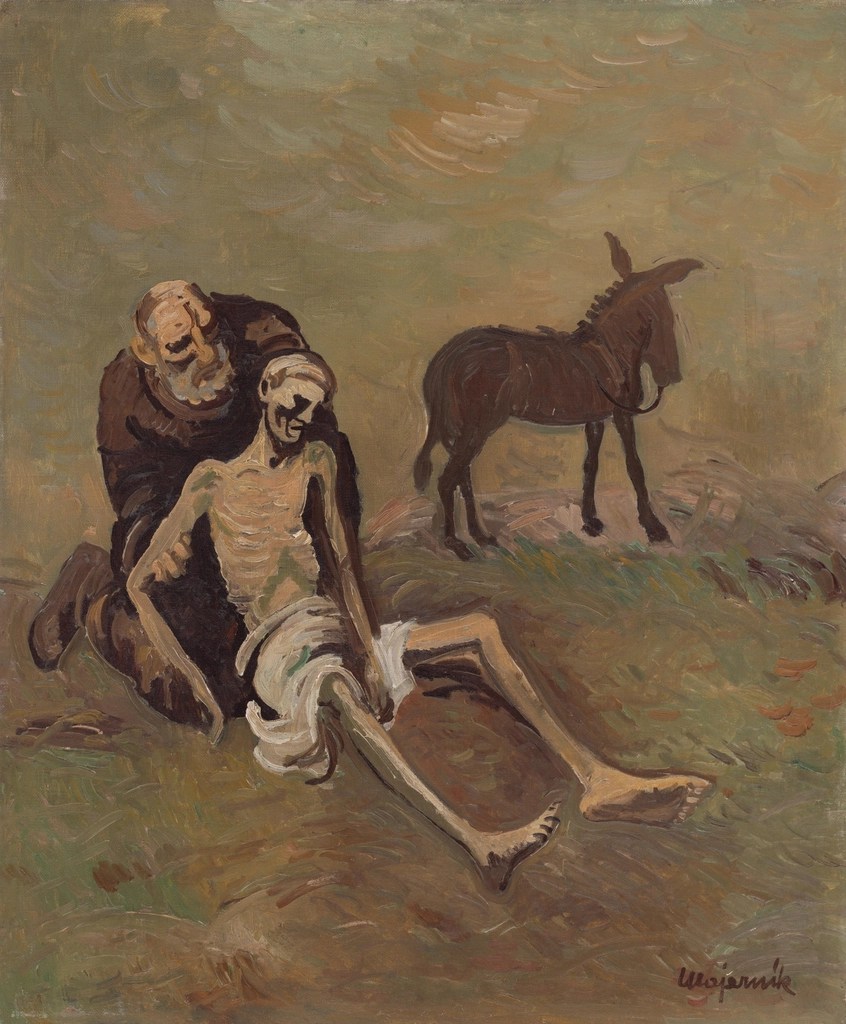
“But he, desiring to justify himself, said to Jesus, “And who is my neighbor?” Jesus replied, “A man was going down from Jerusalem to Jericho, and he fell among robbers, who stripped him and beat him and departed, leaving him half dead. Now by chance a priest was going down that road, and when he saw him he passed by on the other side. So likewise a Levite, when he came to the place and saw him, passed by on the other side. But a Samaritan, as he journeyed, came to where he was, and when he saw him, he had compassion. He went to him and bound up his wounds, pouring on oil and wine. Then he set him on his own animal and brought him to an inn and took care of him. And the next day he took out two denarii and gave them to the innkeeper, saying, ‘Take care of him, and whatever more you spend, I will repay you when I come back.’ Which of these three, do you think, proved to be a neighbor to the man who fell among the robbers?”” (Luke 10:29-36, ESV)
All in all, it is not about the message of participation trophies or a pure “no pain, no gain” philosophy. This is about loving one another as ourselves. And it is about loving ourselves! It is about giving AND seeking out coaching, mentoring, guiding, supporting, all while encouraging one another through the ups and downs of life. Life is inherently a collaborative process and in order to build resilience, we need God, His Spirit, grace, and glory, and our fellow neighbors along the way to serve as accountability partners in our journey.
Stage D: “Refiner’s Gold” Finding Happiness & Humility through Hard work
Before we come to the accountability partner phase of resilience, it’s important to understand the refining, “heat treat” and “final validation” phases of resilience.
The process of smelting is actually quite intense from a capital, process, and well, temperature perspective. Gold melts at nearly 2000 degrees Fahrenheit (that’s over 1000 degrees Celsius). The purpose is of course to remove all of the impurities and extract the pure gold.
This method of heat treating is not only used for jewelry, but is also used for other purposes (e.g. electronics, medical, and other industrial). Did you catch that? It is essentially refined through an ultra-high heat intensive process…for it’s true purpose.
I did not invent this metaphor. In fact it is used several places in scripture.
“And I will put this third into the fire, and refine them as one refines silver, and test them as gold is tested. They will call upon my name, and I will answer them. I will say, ‘They are my people’; and they will say, ‘The LORD is my God.’”” (Zechariah 13:9, ESV)

“He will sit as a refiner and purifier of silver, and he will purify the sons of Levi and refine them like gold and silver, and they will bring offerings in righteousness to the LORD.” (Malachi 3:3, ESV)
The commonly used secular saying is “misery builds character,” or one of the many other varietals stemming from a similar pain-ridden concept. In essence, pain, struggle, discomfort (as we talked about before), all contribute to character building. This is in the same context as our smelting or heat treat methods. When we face pain or any kind of obstacle, we immediately begin to look for ways to overcome or alleviate our problem. This can be either instinctive as part of our physiology, or performed creatively and consciously, through a mindful ideation of “ways to overcome.” It can also be a way to discover bad habits, negative thoughts, or harmful actions we are doing which lead to painful consequences. This process not only involves learning and growth, but also stimulates our interest of a given topic and shows us that even though we may fail or struggle at time, we can overcome! It works out our “grit muscle” and shows our ability to navigate difficult situations, all by the grace of God!
We will revisit Mihaly Csikszentmihalyi again, because he talks a lot about purpose, goals and resilience, but there is a good passage from his book Flow which is relevant here:
”Purpose gives direction to one’s efforts, but it does not necessarily make life easier. Goals can lead into all sorts of trouble, at which point one gets tempted to give them up and find some less demanding script by which to order one’s actions. The price one pays for changing goals whenever opposition threatens is that while one may achieve a more pleasant and comfortable life, it is likely that it will end up empty and void of meaning.” (p. 223)
Okay, yes, that was a bit of a slap in the face, but we are all guilty of this. I know I am very guilty of investing time in developing a plan with SMART goals, OKRs, the lot, and then not even two days in, completely changing course or planning again all over!
Torah (first five books of the Bible) scholars and sages refer to several blessings which describe torah study as involving hard work, happiness and humility [Aish.com]. In fact, hard work symbolizes fire and corresponds to being deeply involved in study – specifically in the context of Torah study. This is further evidenced by the Yiddish word “Fabrent,” which is used to describe someone who is “on fire” or zealously engaged in a topic. This is also where we derive the English word “Fervent.”
This hard work comes before happiness. It is similar to the friction we experience before we start a task. And isn’t it interesting that that is the hardest part. It is almost like we doubt ourselves that we can get started or create scenarios where the task is too difficult or where we fail. It makes one think about how flint makes a fire.
But this is how the adversary works. The adversary wants us to be lazy. The adversary wants us to be lukewarm. And this is why we need to be on fire!
“‘I know your works: you are neither cold nor hot. Would that you were either cold or hot! So, because you are lukewarm, and neither hot nor cold, I will spit you out of my mouth. For you say, I am rich, I have prospered, and I need nothing, not realizing that you are wretched, pitiable, poor, blind, and naked. I counsel you to buy from me gold refined by fire, so that you may be rich, and white garments so that you may clothe yourself and the shame of your nakedness may not be seen, and salve to anoint your eyes, so that you may see. Those whom I love, I reprove and discipline, so be zealous and repent.” (Revelation 3:15-19, ESV)
And we see here that being on fire, or hot, does not mean that we don’t need help. In fact, it’s the people who are on fire who will seek out the most help. Particularly because they will encounter the most obstacles, and need coaching, encouragement, mentoring, feedback and accountability. People who are “going through the motions” don’t ask questions, they don’t ask for help, and they aren’t mindful or engaged in their task at hand. They are also the most humble and most malleable. Their hearts are not hardened.
Our lives following God and spreading His Word are inevitability filled with chaos, disorder, and frustration. But this is the world in which we live. We must embrace the trials and know that we may not always find peace and comfort in every situation. Eventually though, we will find happiness. More of that to come.
“Dear friends, don’t regard as strange the fiery ordeal occurring among you to test you, as if something extraordinary were happening to you. Rather, to the extent that you share the fellowship of the Messiah’s sufferings, rejoice; so that you will rejoice even more when his Sh’khinah is revealed.”
1 Kefa (1 Pe) 4:12-13 CJB
“An intelligent heart acquires knowledge, and the ear of the wise seeks knowledge. A man’s gift makes room for him and brings him before the great.” (Proverbs 18:15-16, ESV)
“Prove me, O LORD, and try me; test my heart and my mind. For your steadfast love is before my eyes, and I walk in your faithfulness.” (Psalms 26:2-3, ESV)
“Commit your work to the LORD, and your plans will be established.” (Proverbs 16:3, ESV)

Stage E: “Return your Returns” Remember It is called a gift for a reason
Think about the most recent time you were truly happy. More than likely it was while you were deeply engaged in something, doing something you love perhaps. Now can you think back to the first time you did this thing. It probably wasn’t easy, was it? And more than likely, it did not bring immediate satisfaction.
In fact, you probably didn’t understand it at all. You probably struggled to find something you could relate to or some part of it which you could attach to something familiar in your mind. God created our brains in this way. That when we learn a new skill, or even practice a skill we know, we a build protein and lipid mixture known as _myelin_in our brains. This wonderful creation acts as a “insulator” between neural pathways, so as to literally build “memory muscles.” In layman’s terms, it speeds the connection between these pathways, like a network cable would do for your home internet.
As Daniel Coyle puts it in his book The Talent Code:
“Struggle is not optional—it’s neurologically required: in order to get your skill circuit to fire optimally, you must by definition fire the circuit suboptimally; you must make mistakes and pay attention to those mistakes; you must slowly teach your circuit. You must also keep firing that circuit—i.e., practicing—in order to keep myelin functioning properly. After all, myelin is living tissue.”
I like to think about our lives and our days in three phases. Learn. Earn. Return. For the sake of our lesson, we can change this to Learn. BURN. Return. See what I did there…
In our first 20 to 30 years of life, we spend most of our time learning and socializing, or learning to fit in with groups and society. The second 20 to 30 years, we normally obtain higher levels of pay and achieve more success in what we have started early on. Then ultimately, the expectation is that we are able to “return” or donate some of what we have learned and earned back to society. This is also a godly principle.
“But if a widow has children or grandchildren, let them first learn to show godliness to their own household and to make some return to their parents, for this is pleasing in the sight of God.” (1 Timothy 5:4, ESV)
However, there is another principle buried deeper here. Perhaps there is really not phases, but rather a cycle. And some of these phases tend to go in parallel or perfect harmony. While we are learning, we are actually burning fat and building muscle. We are redeeming the time and building skills which can be used for His glory and our purpose or calling.
Recall the etymology of the word fervent that we learned above. After we learn, we become zealously engaged, just after we become “good enough.”
These three phases or pieces of the puzzle can be prescribed to our topic of purpose-finding and resilience building. Of course, the first two phases may take a long time to conquer. Yet the beauty of the last phase or puzzle piece is it only takes a few seconds.
Giving is our acknowledgment that we are not the owners. It is the final validation before God of our intention and grace towards others. Giving invokes mercy, generosity, and kindness. It puts others before ourselves. It’s a sign that we understand that our gifts are not ours, but rather given from God.
If we think back to our discussion on the sages describing torah study in three components – hard work, humility and happiness – we can achieve true happiness by giving back. We can say thank you to our Creator, and even exercise humility in the process. But more of that to come.
“As each has received a gift, use it to serve one another, as good stewards of God’s varied grace:” (1 Peter 4:10, ESV)
“Every good gift and every perfect gift is from above, coming down from the Father of lights, with whom there is no variation or shadow due to change.” (James 1:17, ESV)
Stage F: Accountability (Find a partner, Find a Coach)
Admitting we need help is the first step. You have probably heard this saying before, and more often than not, it is used in the context of addiction. However, it can be applied much more broadly, even to our faith.
The simple fact is no one can do it alone. No one. God created woman to be a companion to man, because the fact is men cannot cut it alone. Woman or man. We are codependent beings, where love is to be the focus of all we do.
Another simple fact is that we all dream dreams. We all make plans and God laughs. Because as Robert Kiyosaki said aptly, “Ideas are easy. Implementation is hard.”
It’s easy to say we want something or we want to be something. It’s much harder to actually get started. Let alone, when we start to encounter obstacles (or life for that matter), we tend to throw in the towel or quit before we even start to build enough tolerance or enjoyment in what we are doing.
This is where we need to insert humility. We need to underestimate what we can get done in a day. We need to take smaller steps than we think is reasonable. And we need an accountability partner or coach to help us along the way. An accountability partner asks the right questions. They follow-up intentionally – more often than not simply because they care!
So let us seek out the wisdom the others. Find an accountability partner or coach to keep you grounded, keep you focused, and ask the right questions along the way. These people are closer than you think. You don’t need an executive coach to get you to do the right thing. You need someone who loves you, and perhaps knows you better than you know yourself.
“Without counsel plans fail, but with many advisers they succeed.” (Proverbs 15:22, ESV)
“And let us consider how to stir up one another to love and good works, not neglecting to meet together, as is the habit of some, but encouraging one another, and all the more as you see the Day drawing near.” (Hebrews 10:24-25, ESV)
Takeaways to make a way…
-Sometimes all it takes is a prayer and getting started
-The Obstacle is the Way (as Ryan Holiday puts it)
-Understand struggle as a gift, an opportunity to burn in zealous passion
-Without discomfort, we cannot truly grow
-Remember your gifts are not yours to begin with.
-Find a partner, trust me (and your partner)
Further Study with your Buddy…
Go back to Part 1 of this study if you haven’t read it (or even if you have). It’s called Purpose & Perseverance Part 1: Finding Your Calling, Purpose or Gift
For another type of obstacle and an alternative way to view them, read Divine Distractions.
Questions for Reflection…
What passions have you tried that could potentially be your purpose?
What roadblocks or obstacles have you encountered along the way?
In what way has struggle helped you learn or succeed?
Who have you involved in your journey?
Any potential accountability partners that you can identify?
 godlyyy